
When a neobank’s payment button renders incorrectly on Samsung One UI, customers can’t complete transactions. When a fintech’s biometric login fails on specific Xiaomi variants, support tickets spike. Device fragmentation isn’t a future problem—it’s costing banking and fintech teams real revenue today.
With Android alone supporting thousands of device-OS combinations globally, and iOS introducing new form factors yearly, testing on emulators no longer provides the coverage regulated industries require. Traditional in-house device labs can’t scale to match the pace of device releases. Organizations across banking, healthcare, and enterprise sectors are turning toward cloud-based device farms that provide instant, remote access to real hardware with compliance certifications to match.
Testing on real devices has become mandatory to validate security, user experience, network behavior, and OS variations that emulators cannot fully capture. This guide breaks down the top device farms for 2026, with specific attention to what matters for enterprise and regulated industry testing.
Table of Contents
What Is a Device Farm?
A device farm is a cloud-based platform that gives remote access to real, physical mobile devices for testing. Instead of buying and maintaining your own device lab, teams can access thousands of actual devices hosted in the cloud. This makes mobile app testing more practical and scalable.
These platforms support manual testing, automated scripts, and AI-driven testing approaches across Android, iOS, and web apps.
Key capabilities include:
- Sensor simulation for GPS, accelerometer, camera, and biometric hardware
- Network conditioning to test different connection speeds and reliability
- Biometric authentication testing for fingerprint and face recognition
- Real-world scenario testing across device configurations and OEM variants
- CI/CD integration for continuous automated testing
- Compliance certifications for regulated industries
This setup lets teams validate app behavior under diverse conditions without the cost and complexity of managing physical hardware in-house.
Why Use a Device Farm in 2026?
Device farms have become essential for mobile app testing because they provide access to a wide range of real devices and testing capabilities without expensive in-house labs. They offer a scalable, cloud-based approach that integrates with CI/CD workflows, helping teams deliver high-quality apps faster.
Key benefits include:
- Extensive device and OS coverage to reach diverse user segments across markets
- Testing on actual hardware for accurate sensor, CPU/GPU, camera, and battery behavior
- Immediate scalability to handle fluctuating test requirements and release cycles
- Pay-as-you-go pricing that eliminates large upfront capital costs
- Direct integration with CI/CD pipelines for continuous testing
- Support for distributed teams working across different locations and time zones
- Advanced test automation and AI-driven orchestration features
- Compliance with security standards required by banking, healthcare, and enterprise sectors
For banking and fintech teams specifically, device farms provide the documented test coverage across device types that PCI-DSS audits require—something that’s impossible to achieve with emulator-only testing.
Key Factors to Choose a Device Farm (2026 Buyer’s Guide)
Choosing the right device farm requires looking beyond basic real-device access. As teams replace traditional mobile device lab setups, they need platforms that can scale intelligently, support AI-driven execution, and deliver deep visibility into app performance.
Below are the core factors buyers should evaluate when selecting device farms for Android and iOS in modern testing environments.
1. Number & Diversity of Real Devices
Top device farms should offer a wide range of Android and iOS devices, covering multiple brands, chipsets, screen sizes, OS versions, and custom manufacturer skins. For banking apps, this includes devices popular in your target markets—US, UAE, Singapore—not just flagship phones. More diversity means higher test reliability in production.
2. Low-Latency Remote Device Streaming
Smooth, lag-free device streaming is essential for manual testing, debugging, and live interaction. Platforms must ensure minimal latency regardless of tester location—critical for distributed QA teams.
3. Support for Rooted Devices & Private Cloud Isolation
Rooted Android devices and private, isolated device clouds are critical for BFSI, healthcare, and enterprise-grade testing where deeper access and controlled environments are required.
4. AI-Driven Test Orchestration
Next-gen device farms must support AI engines that optimize test selection, auto-retry logic, self-healing, and intelligent execution paths. These systems reduce manual maintenance by 40-60% for enterprise test suites.
5. Integration With Popular Automation Frameworks
The ideal platform should seamlessly integrate with Appium, Espresso, XCUITest, Selenium, and Playwright to support multichannel test automation and parallel CI/CD workflows.
6. Availability of Detailed Performance Data
Buyers must evaluate whether the farm provides insights such as CPU/GPU usage, memory consumption, FPS, thermal behavior, and network logs for deeper observability. For banking apps, transaction latency metrics are essential.
7. Security & Compliance Standards
Enterprise-grade testing requires compliance with SOC 2, ISO 27001, GDPR, HIPAA, and PCI-DSS. This is especially crucial for apps handling sensitive user or financial data. Without proper certifications, your testing infrastructure itself becomes a compliance gap.
8. Ability to Scale Automated Tests
Modern teams need dynamic scalability—whether running one automation suite or hundreds in parallel. The device farm should handle burst workloads without queue delays during release cycles.
9. Flexible Pricing Model
Look for transparent pricing, whether based on concurrent sessions, usage minutes, or pay-as-you-go. This ensures predictability for teams of all sizes.
10. Enterprise Support & Custom Device Procurement
Large organizations often need dedicated SLAs, guaranteed uptime, and the ability to add custom devices (including specialized hardware like Zebra POS terminals) to the pool. Strong enterprise support is a key differentiator.
Top Device Farms for Mobile App Testing in 2026
Here’s a comprehensive breakdown of the leading device farms, with specific guidance on when each platform fits your testing needs.
1. Pcloudy (Best for AI-Driven Enterprise Testing)
Pcloudy is widely recognized for its innovation in AI-powered real device testing, offering autonomous test creation, self-healing automation, and intelligent orchestration that reduces maintenance effort significantly.
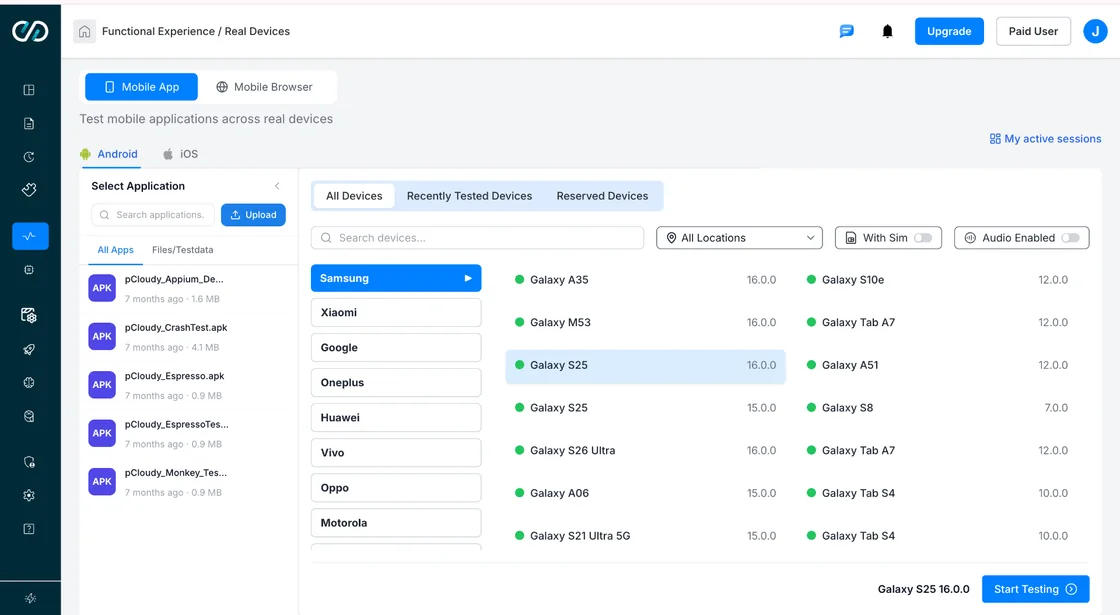
Pcloudy’s online device farm gives instant access to 5,000+ real smartphones and tablets in the cloud—the largest device cloud for regulated industries. The platform eliminates the cost and complexity of maintaining physical hardware while providing compliance certifications required for banking, healthcare, and enterprise testing.
Key Features:
- 5,000+ real Android and iOS devices across OEMs, OS versions, and screen sizes
- AI-driven test creation and orchestration through QPilot
- Self-healing automation that adapts to UI changes
- PCI-DSS compliant infrastructure for banking and fintech testing
- Zebra POS terminal and payment device support for retail banking
- SOC 2, ISO 27001, and GDPR certifications
- Private cloud and rooted device options
- 60+ performance metrics including thermal throttling and network latency
Use Pcloudy when:
- You need advanced AI-driven testing and automatic test healing
- Enterprise security, data isolation, and PCI-DSS compliance are mandatory
- You require wide Android fragmentation coverage across 5,000+ devices
- Your team needs rooted devices or private cloud device environments
- You work in banking, fintech, healthcare, or regulated sectors requiring compliance documentation
- Payment device testing (Zebra POS terminals) is part of your workflow
Read More: Enhance Your Test Automation with Pcloudy Device Farm
2. AWS Device Farm
AWS Device Farm integrates seamlessly with the AWS ecosystem, making it the natural choice for teams using AWS services like CodeBuild, CodePipeline, and CloudWatch. It supports large parallel test execution on real devices, offers detailed logs and performance metrics, and reduces administrative overhead.
Key Features:
- Native integration with AWS CI/CD services
- Pay-per-minute pricing model
- Support for Appium, Espresso, XCUITest, and custom frameworks
- Automated and manual testing options
- Detailed logs, screenshots, and video recordings
Use AWS Device Farm when:
- Your delivery pipeline is heavily integrated with AWS CI/CD
- You need high-volume, parallel execution for large automation suites
- You want a fully managed real-device cloud without operational overhead
- Pay-per-minute pricing aligns with your testing patterns
Read More: The Best AWS Device Farm Alternatives
3. Firebase Test Lab
Firebase Test Lab is Google’s device testing service, giving developers access to a curated set of real and virtual Android devices. It integrates directly with the Play Store, enabling pre-launch reports, stability analysis, and compatibility checks.
Key Features:
- Google-native environment with Play Store integration
- Robo test crawler for automated exploration
- Pre-launch reports for Play Store submissions
- Free tier for basic testing needs
- Integration with Firebase Crashlytics and Analytics
Use Firebase Test Lab when:
- You focus primarily on Android app development and testing
- You want Play Store readiness checks and pre-launch reports
- You prefer a Google-native environment for debugging and device coverage
- Budget constraints make free-tier testing attractive
4. BrowserStack
BrowserStack is one of the most widely used cloud testing platforms, offering access to 3,000+ real iOS and Android devices alongside extensive browser testing capabilities. It’s ideal for teams building responsive apps or experiences that must work consistently across mobile and desktop.
Key Features:
- 3,000+ real devices and 3,000+ browser combinations
- Combined web + mobile testing from unified platform
- Visual testing capabilities (Percy integration)
- Comprehensive debugging with video, logs, and screenshots
- Enterprise-grade reliability with strong uptime SLAs
Use BrowserStack when:
- You want multi-platform (web + mobile) testing from a unified cloud
- You need extensive browser + device coverage for cross-platform apps
- You rely on frameworks like Selenium, Appium, Playwright, or XCUITest
- Proven enterprise reliability is a priority
5. TestMu AI (Formerly LambdaTest)
LambdaTest provides a rapidly growing cloud testing platform known for competitive pricing and comprehensive features. With HyperExecute for orchestration, it offers fast test execution at scale.
Key Features:
- 3,000+ browser and device combinations
- HyperExecute for faster orchestration
- Competitive pricing with flexible plans
- Real-time debugging with video recordings
- Strong CI/CD integrations
Use LambdaTest when:
- Budget-conscious testing without sacrificing coverage
- You need fast orchestration with HyperExecute
- Growing teams seeking scalable infrastructure
- Cross-browser and cross-device testing is equally important
6. Sauce Labs
Sauce Labs is one of the largest and most established cloud testing platforms, offering extensive browser and device coverage with enterprise-grade analytics and reliability. It’s trusted by large organizations requiring proven infrastructure.
Key Features:
- 2,000+ real devices with extensive OS version coverage
- Enterprise-grade analytics and error reporting
- Video playback and detailed debugging logs
- Strong CI/CD integration ecosystem
- SOC 2 and ISO 27001 compliance
Use Sauce Labs when:
- Enterprise reliability and proven track record matter most
- You need comprehensive analytics beyond basic test results
- Large-scale parallel execution is standard for your team
- Combined web + mobile testing at enterprise scale
7. HeadSpin
HeadSpin offers a global device infrastructure with real devices in 90+ locations worldwide. It excels at performance testing under real network conditions and provides AI-driven analytics for quality of experience (QoE) monitoring.
Key Features:
- Real devices in 90+ global locations
- Real-world network condition simulation (3G/4G/5G)
- AI-driven performance analytics and QoE insights
- SIM-enabled devices for true network testing
- Strong media and streaming app testing capabilities
Use HeadSpin when:
- Geolocation testing across global markets is critical
- You need real-world network condition simulation
- Performance analytics and QoE insights are primary requirements
- Media streaming or audio/video app testing is your focus
- Testing from specific geographic locations matters for your users
8. Kobiton
Kobiton provides AI-driven scriptless testing with real device cloud and private lab options. It’s known for fast test execution and flexible deployment models.
Key Features:
- AI-driven Appium script generation
- Self-healing test scripts
- Private device lab management
- Scriptless test automation option
- Cloud, on-premise, and hybrid deployment
Use Kobiton when:
- Scriptless automation appeals to your team
- You want to manage your own private device lab
- Flexible deployment (cloud/on-premise/hybrid) is required
- AI-assisted test creation reduces maintenance burden
Side-by-Side Comparison Table
| Platform | Devices | Platform Support | AI Features | Compliance | Pricing | Best For |
|---|---|---|---|---|---|---|
| Pcloudy | 5,000+ | Both strong | QPilot autonomous testing, self-healing | PCI-DSS, SOC 2, ISO 27001, GDPR | Enterprise subscription | Banking/fintech needing compliant AI-driven testing |
| AWS Device Farm | 2,500+ | Both | Limited | SOC 2 | Pay-per-minute | AWS-native teams with high-volume automation |
| Firebase Test Lab | 100+ physical | Android-focused | Robo test crawler | Google Cloud | Free tier + usage | Android-first teams wanting Play Store integration |
| BrowserStack | 3,000+ | Both strong | Visual AI (Percy) | SOC 2 | Subscription tiers | Web + mobile cross-platform testing |
| LambdaTest | 3,000+ | Both | HyperExecute orchestration | SOC 2 | Flexible subscription | Budget-conscious teams needing scale |
| Sauce Labs | 2,000+ | Both | Error analytics | SOC 2, ISO 27001 | Enterprise | Large enterprises needing reliability |
| HeadSpin | 1,000+ (90 locations) | Both | AI performance analytics | Enterprise | Premium | Global performance and geolocation testing |
| Kobiton | 350+ | Both | Script generation, self-healing | Enterprise | Subscription | Teams wanting scriptless automation |
When to Use Which Device Farm: Quick Reference
| Your Primary Need | Recommended Platform |
|---|---|
| AI-driven testing with compliance certifications | Pcloudy |
| AWS-native CI/CD integration | AWS Device Farm |
| Android-focused with Play Store integration | Firebase Test Lab |
| Combined web + mobile testing | BrowserStack or LambdaTest |
| Enterprise reliability at scale | Sauce Labs |
| Global geolocation and performance testing | HeadSpin |
| Scriptless automation with private labs | Kobiton |
| Banking/fintech with PCI-DSS requirement | Pcloudy |
| Budget-conscious scaling | LambdaTest |
Emerging Trends: Device Farms in 2026 and Beyond
Device farms are shifting from simple real-device access to intelligent, autonomous testing platforms. Here are the key trends shaping the future:
AI Agents for Autonomous Testing
AI agents explore app flows, identify issues, and create test cases automatically. They learn from user interactions and continuously improve test coverage without requiring constant manual updates. Platforms like Pcloudy’s QPilot lead this evolution.
Multi-Agent Orchestration
Multiple AI agents work together on different tasks simultaneously—exploration, regression, performance checks, and accessibility testing. This parallel approach speeds up validation compared to sequential testing.
Digital Twin Environments
Digital twins recreate real-world conditions including devices, sensors, and user behavior patterns. Teams can validate how apps perform under actual constraints before going live, catching problems earlier in the development cycle.
5G and Advanced Network Simulation
Device farms now simulate next-generation connectivity including 5G with various signal conditions. Apps get tested against real-world network scenarios that affect performance, latency, and user experience.
Foldable and Wearable Device Support
Coverage now includes foldables, wearables, and emerging form factors. Testing covers hinge behavior for foldables, sensor scenarios for wearables, and multi-screen app experiences.
Enterprise-Grade Private Device Pods
Large companies are setting up isolated, secure device clusters for internal teams. These private setups meet compliance requirements, maintain data protection, and allow organizations to provision specific devices they need.
Predictive Defect Analytics
AI systems analyze performance data, logs, and historical test results to predict where failures might occur. Testing moves from reactive bug-finding to proactive prevention.
Autonomous Debugging and Root Cause Analysis
Root cause analysis gets automated—systems identify the exact source of failures whether it’s UI, API, network, memory, or device-specific issues. Teams get clear answers without manual log analysis.
Conclusion
Device farms have become essential tools as mobile device fragmentation continues to grow exponentially. With Android alone supporting thousands of active device models and OS versions across global markets, comprehensive real-device testing ensures seamless app performance for all users.
For banking and fintech teams, the stakes are higher. A payment flow that fails on specific OEM variants means lost transactions and compliance questions. Biometric authentication that works in emulators but fails on real hardware means frustrated customers and support escalations.
When evaluating device farms, prioritize platforms that offer the device coverage your users actually have, the compliance certifications your industry requires, and the AI capabilities that reduce manual maintenance as your test suite grows.
Looking ahead, AI-powered real devices will dominate mobile app testing. Autonomous AI agents, predictive analytics, and advanced network simulations integrated into device farms enable faster, more intelligent quality assurance—helping teams ship reliable, high-performing apps in an increasingly complex ecosystem.
Ready for AI-powered testing on 5,000+ real devices? Try Pcloudy’s Device Farm for enterprise-grade testing that handles fragmentation, security, and AI orchestration with ease.
FAQs on Top Device Farms
What is a device farm in mobile app testing?
A device farm is a cloud-based service providing access to real physical devices for testing mobile apps remotely. It eliminates the need for maintaining in-house device labs while supporting manual and automated testing across diverse Android and iOS configurations.
Are real device clouds better than emulators?
Yes. Real device clouds accurately replicate hardware sensors, network conditions, battery behavior, and OS-specific quirks that emulators cannot fully simulate. They ensure reliable validation of user experience and performance in actual environments—especially critical for payment flows and biometric authentication.
How do device farms work for Android and iOS apps?
Device farms host real Android and iOS devices in secure data centers, allowing remote access via web browsers or automation frameworks like Appium, XCTest, Espresso, Flutter, etc. Testers upload apps, select devices, and run tests with full hardware access including cameras, GPS, and biometric sensors.
Which device farm is best for enterprise testing?
Pcloudy excels for enterprise testing with 5,000+ real device and browser combinations, AI-driven orchestration through QPilot, PCI-DSS compliance for banking, and security certifications including SOC 2, ISO 27001, and GDPR.
Which device farm is best for banking app testing?
Pcloudy is the top choice for banking apps due to its PCI-DSS compliant infrastructure, 5,000+ real device and browser combinations, Zebra POS terminal support, and AI-powered automation. It provides compliance documentation required for regulatory audits in the BFSI sector.
What is the most cost-effective device farm?
AWS Device Farm offers cost-effectiveness through pay-per-minute pricing for high-volume automated testing. LambdaTest provides competitive subscription pricing for teams needing scale without enterprise budgets.
Do device farms support AI-driven automated testing?
Yes. Modern device farms like Pcloudy integrate AI agents for autonomous test creation, self-healing scripts, and predictive analytics, significantly reducing manual maintenance and improving test coverage.
Can device farms be integrated with CI/CD pipelines?
Absolutely. All major device farms (Pcloudy, AWS, BrowserStack, Sauce Labs, LambdaTest) provide APIs and plugins for seamless Jenkins, GitHub Actions, GitLab CI, and Azure DevOps integration, enabling continuous automated testing.
Read more: Pcloudy Integrations: CI/CD & Automation Testing Frameworks
Do device farms support PCI-DSS compliance for payment testing?
Enterprise device farms like Pcloudy offer PCI-DSS compliant infrastructure. This includes encrypted test data, secure device access, isolated testing environments, and audit trails required for payment card industry compliance.
Can I test biometric authentication on device farms?
Yes. Real device clouds like Pcloudy support biometric testing including Touch ID, Face ID, and fingerprint authentication on actual hardware. Emulators cannot accurately simulate biometric hardware behavior, making real devices essential for authentication testing.
Read More:


 Veethee Dixit
![Best Bug Tracking Tools for QA Teams [2026]](https://pcloudyprod-engpgtajd7c4g9a8.a03.azurefd.net/wp-content/uploads/2026/08/bug-tracking-tools-thumbnail.jpg)

 Jeroline


