Fortune Business Insights and GlobeNewswire reports that the global FinTech market is expected to reach USD 882.30 billion by 2030, growing at a CAGR of 17% from 2023 to 2030. As digital finance becomes more mainstream, the pressure to deliver secure, reliable, and regulation-compliant financial apps is higher than ever.
In this fast-paced environment, financial application testing is no longer optional. It’s a strategic necessity to ensure flawless functionality, data security, and user trust across every device and transaction.
Claim 180 free minutes on real Android and iOS devices.
Test on Devices
What is FinTech Application Testing?
Fintech application testing evaluates mobile applications and softwares that operate on financial information to ensure that these Fintech organizations adhere to strict compliance, functionality, performance, and security standards. Financial application testing includes everything in that range, from validating secure authentication processes and transactions to verifying regulatory compliance and data encryption. Such a specialized testing level helps avoid downtime, data breaches, and expensive errors in digital financial services.
Why is Financial Application Testing Important?
Since financial apps are responsible for handling real-time transactions and highly sensitive user data, conducting FinTech testing is crucial since even the most minute glitch could result in legal penalties or significant losses. Testing also safeguards user information, ensures GDPR and PCI-DSS compliance, and ensures seamless processing of transactions. Highly reliable testing processes and platforms in the FinTech industry build user trust, improve app stability, and mitigate the risks of costly fixes post-launch.
Key Factors to Consider for Financial Application Testing
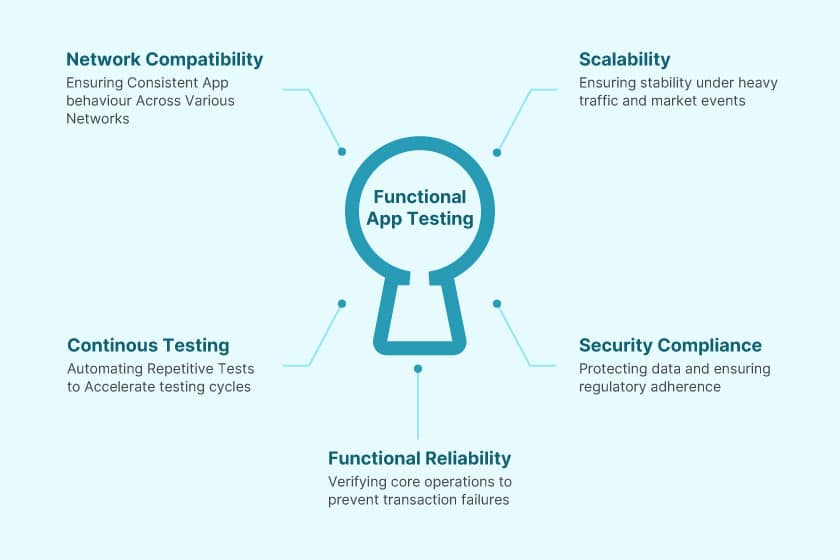
Testing financial apps demands comprehensiveness in the approach because of the critical nature of business processes and sensitive data. Let’s check out some key factors to prioritize:
- Continuous Testing and Automation
It’s recommended that repetitive test cases like notifications, transaction validation, and login flows be automated to support CI and continuous delivery and accelerate the testing cycles.
- Network and Device Compatibility
Users have access to financial services on various networks and devices. So, to ensure consistency in application behavior in different environments, QA teams should give key emphasis to comprehensive testing across different simulated Network conditions, such as unstable Wi-Fi, 2G, 3G, 4G, 5G, etc., and real devices.
- Functional Reliability and Accuracy
It’s critical for core financial operations such as user authentication, loan approvals, and fund transfers to flawlessly work every single time, which is why functional testing is necessary to verify them across different user scenarios, OS versions, and devices to prevent errors for transaction failures.
- Scalability and Performance
This is especially true during market events, which makes stress and load testing essential to ensure the app’s stability and responsiveness under varying network conditions or heavy traffic.
- Security, Regulatory Compliance, and Data Protection
Financial apps process confidential information and revolve around monetary transactions, which makes privacy, data protection, and security paramount. Therefore, the testing process should always include fraud detection mechanisms, encryption, validation, vulnerability assessments, penetration testing, and compliance with regulations such as GDPR and PCI-DSS.
Read More: Why Leading Banks Are Rapidly Adopting Synthetic Monitoring for Digital Success
Core Focus Areas in FinTech App Testing
Claim 180 free minutes on real Android and iOS devices.
Test on Devices
FinTech apps operate in a high-stakes environment. Therefore, effective testing must cover several critical focus areas to ensure flawless functionality and regulatory compliance.
- Security & Data Protection
With financial transactions and personal data at stake, apps must be rigorously tested for vulnerabilities, encryption protocols, and secure data handling to prevent breaches and fraud.
- Functional Accuracy
Every feature, from login and KYC verification to fund transfers and real-time notifications, must function flawlessly across devices and OS versions. Functional testing ensures that business-critical workflows work as expected in every scenario.
- Regulatory Compliance
FinTech apps must adhere to standards like PCI-DSS, GDPR, and PSD2. Testing processes must validate compliance through audit-ready reporting, access controls, and secure environments that mimic real-world financial ecosystems.
- Device & Network Compatibility
Since users access financial services on diverse devices and under varying network conditions, compatibility testing across a wide range of real devices, operating systems, and network profiles is essential.
- Performance Under Load
Apps must handle peak usage like salary days or IPO events, without crashing or slowing down. Load and stress testing help ensure system reliability under high concurrent user traffic.
- Test Automation & Continuous Integration
Automated testing for repetitive scenarios like authentication, transactions, and notifications accelerates release cycles. Seamless integration with CI/CD pipelines ensures continuous quality checks during development.
- User Experience & Accessibility
Visual testing and usability checks help identify UI glitches, broken layouts, or accessibility issues that could impact user trust and satisfaction, especially critical in finance apps where clarity and trust are key.
By covering all these focus areas, FinTech teams can ensure their applications deliver secure, seamless, and scalable user experiences ready for real-world financial demands.
Financial Application Testing Methodologies
Financial application testing calls for a multifaceted approach which can address unique functionality, compliance, and security challenges specific to the financial sector. Therefore, employing a broad array of testing methodologies ensures thorough validation of all critical aspects. Here are some key strategic testing methodologies for the FinTech sector.
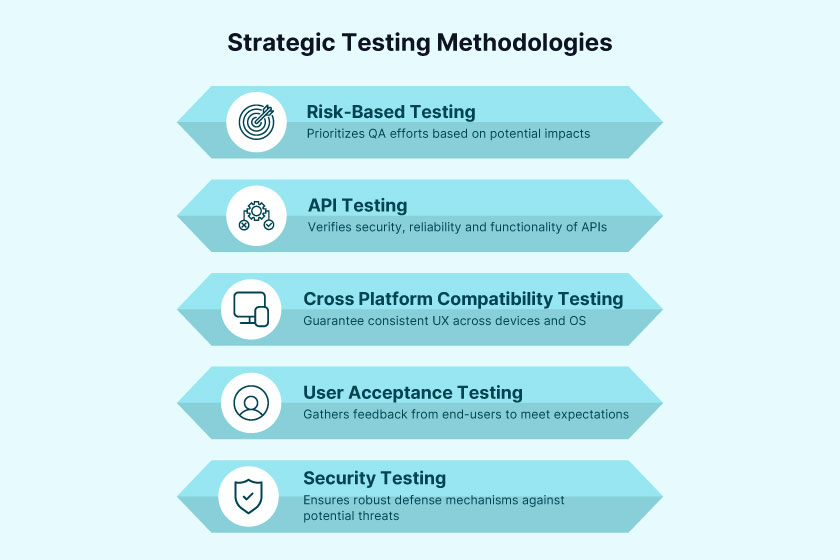
- Security Testing
Security testing, including penetration testing, is an indispensable process to ensure the robustness of the application’s defense mechanisms and to recognize potential threats.
- User Acceptance Testing
This methodology involves engaging the end users in testing to collect feedback on the usability and functionality of the FinTech app. UAT is vital to ensuring that the FinTech app meets the actual expectations and needs of the target audiences.
- Cross-Platform Compatibility Testing
It’s important for FinTech apps to offer a highly consistent UX across different OS and devices. Therefore, compatibility testing ensures users’ access to functional and reliable financial services regardless of the device they choose.
- API Testing
Considering how interconnected FinTech ecosystems are, it’s important to test APIs for security, reliability, and functionality. Thanks to seamless integration between platforms and services, UX is enhanced.
- Risk-Based Testing
Risk-based testing is a methodology that prioritizes QA efforts based on the potential impacts and risks of app functionality. Such an approach concentrates resources on areas that could significantly impact customer satisfaction and operational integrity.
Read More: Mobile First Testing Strategies for Digital Banks: How QA Teams Can Drive Flawless App Experiences
FinTech App Testing Process
The FinTech app testing process is a strategically curated sequence of steps designed to systematically verify that these applications adhere to regulatory requirements, security, and standard business requirements before deployment. Let’s check out the detailed breakdown:
1. Requirement Analysis
It all starts with an in-depth understanding of the business objectives, compliance obligations, and functional requirements. It includes an analysis of user journeys like transaction histories, identity verification, fund transfers, security needs, and regulatory standards.
2.Test Planning
On the basis of the above requirements, the second step is to craft a detailed test plan. It’s a document that outlines the testing score, and defiance compliance, performance, security, functional, and different test types. It narrows down environments and tools, and makes timelines. This plan ensures that all critical education and financial workflows are covered doing testing.
3. Environment Setup
It’s vital to set up realistic test environments, including the use of network visualization for simulating various connectivity scenarios, ensuring configuration of network tunnels to test behind firewalls, and provisioning of real mobile devices. Such conditions do a great job mimicking real user environments for better result accuracy.
4. Designing Test Cases
Testers design comprehensive test cases in this step covering core functionalities like notification, delivery, phone transfer, payment processing, KYC verification, and user authentication. Such test cases also comprise compliance checks, boundary tests, and negative scenarios to further ensure robustness.
5. Test Execution
Whether manually or through automation frameworks, this step involves the execution of test cases across a huge matrix of network conditions and devices. It also includes defect logging with detailed logs, screenshots, and reproduction steps.
6. Validating Security and Compliance
The QA team ensures detailed compliance verifications and security audits to identify any regulatory gaps or vulnerabilities. They include validating audit, trail completeness, verifying access control, checking data encryption, and penetration testing.
7. Load and Stress Testing
Load testing ensures app responsiveness during transaction peaks by simulating concurrent users whereas stress testing is responsible for identifying any breaking points to ensure scalability in real user environments.
8. Managing Defects and Retesting
This involves prioritizing logged issues and retesting to confirm whether the resolution works. Such an iterative process keeps going on until the app adheres to predefined quality standards.
9. Reporting & Sign off
The last step is to prepare a comprehensive test report that summarizes risk assessments, compliance status, defect trends, and coverage so that stakeholders can review the outcomes and offer a formal sign off. Once they give the green signal, the app is ready for release!
Claim 180 free minutes on real Android and iOS devices.
Test on Devices
How Pcloudy Is Revolutionizing FinTech App Testing
Testing can’t be left to chance in the high-stakes world of FinTech, where user trust, security, and real-time functionality are non-negotiable. Pcloudy, a next-gen mobile app testing platform, is transforming the way FinTech companies test and launch mobile apps by offering features tailored to the unique demands of this fast-evolving sector.
- Real-Device Testing Under Real Banking Conditions
Pcloudy provides access to a vast cloud of real mobile devices, allowing QA teams to test on actual smartphones and tablets under conditions that mimic real user environments. This is critical for FinTech apps where even a minor discrepancy in device performance can lead to failed transactions or customer drop-offs.
- End-to-End Automation for Secure Transaction Flows
With deep support for Appium, Espresso, and other major frameworks, Pcloudy lets testers automate complex FinTech workflows like KYC, UPI, and multi-factor authentication. Its secure tunnel technology ensures testing behind firewalls, crucial for simulating secure bank-like environments.
- Performance Testing with Network Virtualization
FinTech apps must remain stable under fluctuating network conditions. Pcloudy’s network simulation lets you test app behavior across 2G, 3G, 4G, 5G, and unstable WiFi scenarios to ensure apps function smoothly even in low-connectivity zones, a common challenge in digital banking.
- Compliance-Ready Test Environment
Pcloudy’s infrastructure is designed with data privacy in mind, supporting compliance with global standards like GDPR and ISO 27001. For FinTech teams handling sensitive financial data, this makes Pcloudy a trustworthy partner for testing at scale.
- Seamless CI/CD Integration
To meet rapid release cycles, Pcloudy integrates effortlessly with Jenkins, GitLab, and other DevOps tools, ensuring that automated tests fit neatly into your continuous delivery pipeline.
- Visual Testing & Crash Reports That Matter
Visual UI regressions and undetected crashes can be revenue killers in FinTech. Pcloudy’s AI-powered smart analytics helps identify visual bugs, track crashes, and spot performance lags before your users ever experience them.
Also Check Out: Pcloudy’s BFSI Success Stories & Case Studies
Financial Application Testing Best Practices
- Build Security and Compliance into Every Layer
Start testing with security in mind. Encrypt sensitive data, perform penetration tests, and validate compliance with PCI-DSS, GDPR, and PSD2 regulations. Include test cases for user consent, audit trails, and secure authentication flows.
- Test in Real-World Environments
Use real devices and simulate varying network conditions (3G/4G/5G, Wi-Fi drops, roaming) to reflect actual user experiences. This uncovers performance and functional issues that only emerge in real usage scenarios.
- Automate High-Impact Test Cases
Automate repetitive and critical tests such as login, fund transfers, and payment processing—to accelerate feedback cycles and maintain consistent coverage. Integrate with CI/CD pipelines to support continuous delivery.
- Validate End-to-End Financial Workflows
Go beyond the UI to test full transaction flows, including backend processing, third-party integrations, and data consistency. Ensure the system handles success, failure, and edge cases gracefully and securely.
- Monitor Performance Under Load
Simulate peak traffic to verify that the app can handle high transaction volumes without lag or downtime. Performance testing (load, stress, and endurance) helps uncover bottlenecks before users experience them.
By focusing on these five pillars, FinTech teams can deliver functional, resilient, security compliant, and user-trusted applications in a rapidly evolving financial landscape.
Conclusion
FinTech app testing is the backbone of secure, compliant, and seamless digital finance experiences. As user expectations and regulatory demands grow, having a focused testing strategy is no longer optional. Platforms like Pcloudy make this easier with real-device access, automation, and compliance-ready environments built for FinTech. Ready to future-proof your testing? Start your 30-day free trial with Pcloudy today.
Claim 180 free minutes on real Android and iOS devices.
Test on Devices
FAQs
How is FinTech app testing different from regular app testing?
FinTech testing demands extra focus on encryption, transaction integrity, fraud prevention, and compliance with laws like PCI-DSS, GDPR, and local banking regulations.
How often should a FinTech app be tested?
FinTech apps should undergo continuous testing before every release, after significant code changes, and periodically for performance and security audits.
Can FinTech app testing be automated?
Yes. Most repetitive test cases can be automated, including login flows, transaction validation, and form submissions. However, critical security and compliance checks often require manual testing.
How do you test for compliance in FinTech apps?
Compliance testing involves validating app behavior against regulatory standards like GDPR, PSD2, PCI-DSS, etc., and ensuring that data handling, storage, and user privacy policies are strictly followed.
Is cloud-based testing suitable for FinTech apps?
With secure platforms like Pcloudy that offer encrypted tunnels, real-device access, and compliance-ready environments, cloud testing is efficient and safe for FinTech apps.
Claim 180 free minutes on real Android and iOS devices.
Test on Devices

 Jeroline

 Nazneen Ahmed