
There are always these seven questions that users silently ask every time they open an app.
- Does it work?
- Is it fast?
- Can I trust it?
- Will it behave consistently on my device?
- Will it fail when I need it most?
And in it all the important realization was this: users never separate quality into categories. They do not distinguish between a functional bug, a performance bottleneck, or a visual inconsistency. To them, it is all one experience. One impression. One decision about whether your product deserves another session tomorrow.
TL;DR
But inside most engineering organizations, quality is still fragmented.
Functional testing happens in one system. Performance testing happens in another. Visual validation often becomes a manual afterthought. Different dashboards. Different pipelines. Different teams interpreting different signals.
Test on real devices. Ship with confidence.
The result is predictable: disconnected visibility and delayed understanding.
Because modern app failures rarely belong to just one category.
A screen that freezes may appear to be a performance issue until investigation reveals a rendering problem triggered by memory pressure on a specific device configuration. A visual regression may actually stem from functional instability. A failed checkout flow may only reproduce under thermal throttling on mid-range hardware.
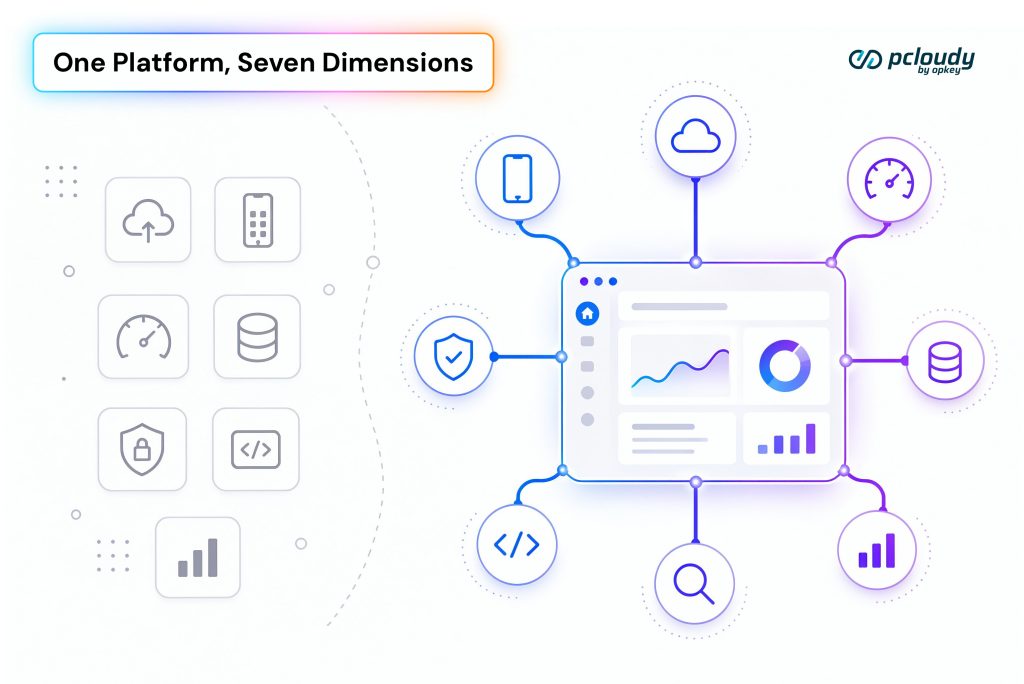
Quality signals are interconnected. Which means the testing stack needs to be interconnected too. That is where the conversation changes.
- Not from “how do we automate more testing?”
- But from “how do we create a single operational view of user experience?”
That shift matters because the future of testing is no longer about isolated execution. It is about correlated intelligence. And that starts with the foundation.
Functional Testing: The Limits of Automation Without Context
Functional testing is where most QA strategies begin. It is also where many teams quietly hit a ceiling. At first, automation creates velocity. Test coverage expands. Regression cycles shrink. Releases become more frequent.
Then complexity catches up. Suites become harder to maintain. Failures become inconsistent. Flaky tests multiply. Investigation cycles grow longer. Teams spend more time debugging automation than identifying product risk. Most organizations assume the issue is the framework.
Usually, it is not. The issue is context.
Traditional automation often runs in environments that remove the unpredictability users actually experience. Stable emulators. Controlled network conditions. Identical hardware profiles. Clean memory states. But production environments are messy.
Users operate on fragmented Android ecosystems, carrier-modified operating systems, aging devices, inconsistent memory availability, and unpredictable background activity. That variability is exactly where critical defects emerge.
This is where real device testing changes the conversation.
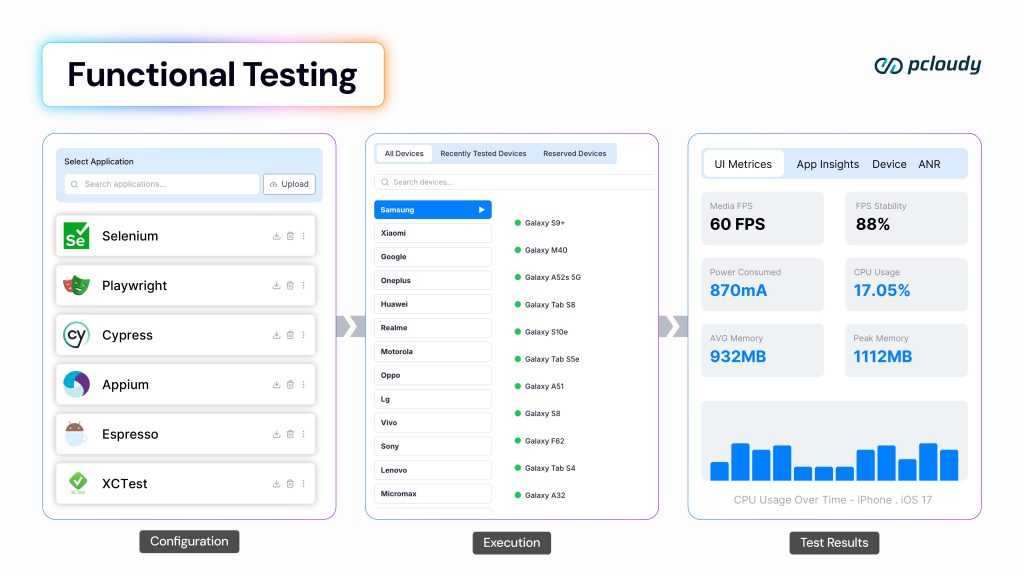
Instead of validating whether a flow works in theory, teams validate whether it works in reality.
A login flow that succeeds on an emulator may fail on a carrier-specific OS build. A payment screen may freeze only on devices with aggressive memory optimization. A form submission may break on older iOS versions still actively used by a meaningful percentage of customers.
- Those are not edge cases.
- Those are production realities.
- The difference becomes even more important during investigation.
Test on real devices. Ship with confidence.
One of the biggest hidden costs in testing today is reproduction time. A defect is reported. The team attempts to recreate the issue. Logs are incomplete. Device states differ. The debugging cycle stretches across hours or days.
Modern testing workflows reduce that gap dramatically. When a failure occurs on a real device environment, the evidence already exists: screen recordings, device logs, crash traces, execution timelines, and environmental data captured automatically during execution.
- The investigation starts from the failure itself, not from guesswork.
- And that fundamentally changes release velocity.
- Because faster testing is not just about execution speed. It is about shortening the distance between detection and understanding.
- That is the real acceleration layer.
Performance Testing: Measuring Conditions, Not Just Speed
Performance testing may be the most misunderstood discipline in mobile quality engineering. Because many organizations still measure performance in ideal conditions while users experience performance in real ones. There is a massive difference between the two.
An application may appear stable on a flagship device connected to office WiFi under controlled lab conditions. But that same experience can degrade rapidly on mid-range hardware under thermal pressure with fluctuating network quality and multiple background processes competing for resources.
That gap between measured performance and experienced performance is where user frustration begins. And users rarely describe it technically.
They do not say:
- “The CPU utilization crossed acceptable thresholds.”
- They say:
- “This app feels slow.”
That sentence alone impacts retention, conversion, engagement, and trust. Which means performance testing can no longer be treated as a benchmarking exercise. It must become an experience validation layer.
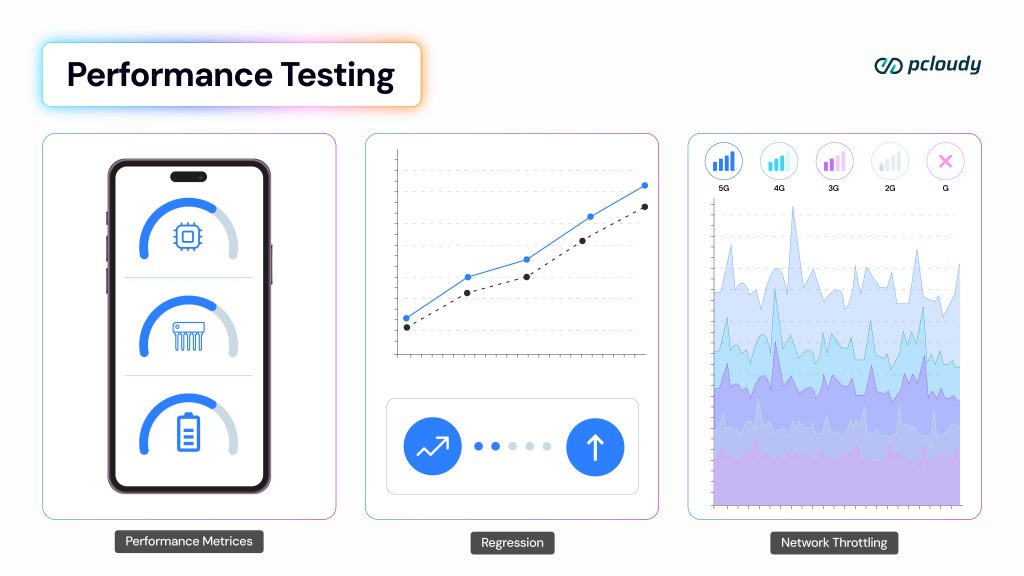
Real device performance analysis exposes the signals synthetic environments often miss entirely:
- CPU spikes during sustained interactions.
- Memory leaks that compound over long sessions.
- Battery drain patterns that accelerate abandonment.
- Thermal throttling that degrades responsiveness over time.
- These issues rarely appear during short execution windows. They emerge through realistic usage behavior.
- That is why baselining matters.
When every build is compared against previous device-specific performance baselines, regressions become visible immediately instead of surfacing weeks later in production analytics or app store reviews.
A 15 percent degradation on a mid-range Android device may never appear on a premium flagship device. But for large user populations globally, that mid-range device is the primary customer experience. And network simulation introduces another critical layer.
Many mobile apps are still optimized for connectivity environments that users do not consistently have. Testing exclusively on strong WiFi connections creates a dangerous illusion of stability. Real users move through elevators, transit systems, crowded public areas, and fluctuating cellular zones.
Applications need to perform under degraded conditions, not just ideal ones. 2G, 3G, 4G, 5G, intermittent connectivity, offline transitions — these are not secondary scenarios anymore. They are part of the default mobile experience. Performance testing becomes far more valuable when it validates resilience, not just speed.
- Because users are not measuring milliseconds.
- They are measuring frustration.
Visual Testing: The Most Silent Quality Failure
Visual issues are uniquely dangerous because they often bypass traditional alert systems completely.
- The app does not crash.
- The API still responds.
- Functional flows technically work.
- But trust begins to erode anyway.
A truncated message, a misaligned button, a layout shift on a specific screen density, a contrast issue that makes content harder to read outdoors. Small inconsistencies create a subtle but cumulative perception that the experience is unreliable. And perception matters more than teams often realize. Users interpret visual instability as product instability.
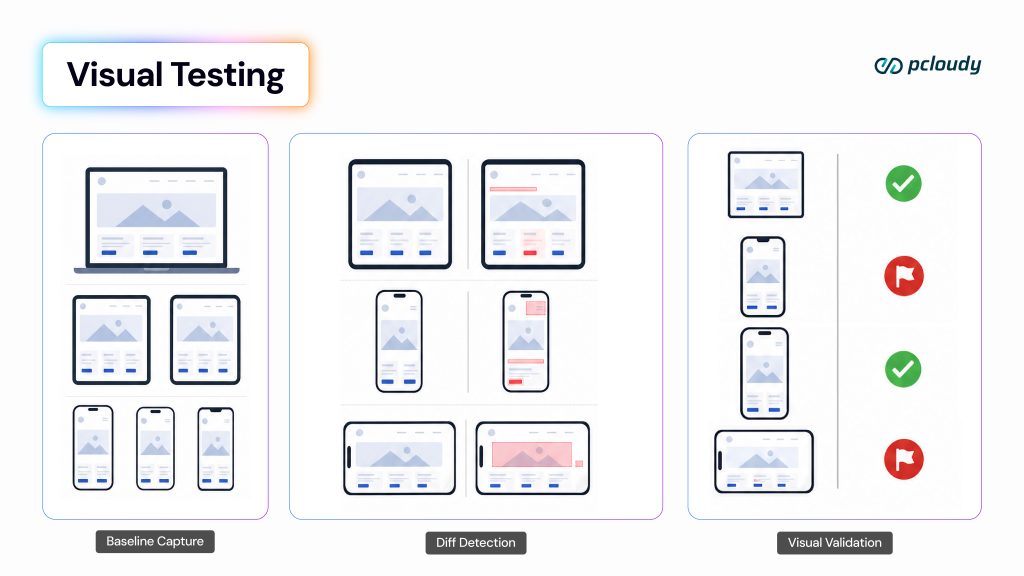
What makes visual testing particularly difficult is the sheer diversity of display environments. Screen sizes, pixel densities, rendering engines, operating system behaviors, and manufacturer-level display calibrations all influence how an interface actually appears.
An experience that looks polished on one device may feel broken on another. That is why screenshot comparisons alone are not enough. Modern visual testing requires baseline intelligence across real hardware environments. When every build is automatically compared against established visual baselines across a real device matrix, regressions become measurable instead of subjective.
Pixel-level diff detection identifies exactly what changed, where it changed, and on which configurations the issue appears. That specificity matters. Because “something looks different” is not actionable.
But identifying the exact regression region on the exact device configuration creates immediate clarity for developers and designers alike. At scale, threshold management becomes equally important. Not every visual change is a defect. Some are intentional design evolutions. Effective visual testing systems distinguish between expected changes and harmful regressions without flooding teams with false positives.
- That balance is critical.
- Because noisy quality systems eventually become ignored quality systems.
- And ignored signals are often more dangerous than missing ones.
The Bigger Shift: From Testing Types to Unified Quality Intelligence
Functional testing, Performance testing and Visual testing. For years, organizations treated these as separate disciplines. But users never experience them separately. A performance regression can trigger a visual inconsistency. A visual issue can expose a functional instability. A functional failure may only surface under specific performance conditions.
The signals are connected whether organizations choose to see the connection or not. That is why the real evolution in testing is not simply broader automation coverage. It is unified visibility. When multiple testing dimensions operate on the same device foundation, inside the same workflow, with correlated reporting and shared execution context, patterns become visible that isolated tools cannot expose.
Test on real devices. Ship with confidence.
The platform becomes more than a testing environment, it becomes an operational intelligence layer for product quality. And this matters even more as release velocity accelerates. Because modern engineering teams are no longer struggling to ship software. They are struggling to understand software behavior fast enough to maintain confidence while shipping continuously. That is the next challenge quality engineering must solve.
- Not just detecting defects, Detecting relationships between defects.
- Not just generating reports, Generating actionable signals.
- Because the future of testing is not more dashboards, It is clarity.
- And clarity only happens when every dimension of quality contributes to the same picture.
- Seven dimensions, One foundation, One connected signal.
Read More:
- Seven Dimensions of Quality And Why They All Need the Same Foundation
- Build the Right Stack: The Foundation Problem in Modern Testing
- Why We Chose to Build a Stack Instead of Just Another Tool
- Testing at a Scale: How One of India’s Biggest Telecom Players Fixed Scaled Their Testing
- Best 7 Android Emulators for Mac
- Best 10 Android Emulators for Chromebook
- Best 10 iOS Emulators for PCs
- Best 10 Mac Emulators for PCs