Vibe coding is one of the processes that has reshaped software development. It’s understandable why it’s important for quality assurance professionals to keep up with vibe testing. In simple terms, testers give plain language descriptions, and AI deals with the rest, which results in adaptive, user-focused, and quicker testing.
Since the AI testing market valued at $736 million in 2023 is estimated to rise to $2.74 billion by the year 2030, taking a deep dive into vibe testing is even more crucial. In this article, we’ll take a dive deep into the top 10 vibe testing tools in 2026 and other relevant details about vibe testing.
Table of Contents
What is Vibe Testing?
Vibe testing is an AI-powered software testing methodology where QA teams describe test scenarios in natural language (plain English) rather than writing code, and specialized AI agents automatically generate, execute, and maintain the tests.
Unlike traditional test automation requiring scripting expertise, vibe testing enables non-technical team members—including product managers, designers, and business analysts—to contribute directly to quality assurance while AI handles test adaptation as applications evolve.
Importance of Vibe Testing for Mobile App Development
Since the nature of mobile apps is to rapidly evolve with AI-powered features and changes in UI, traditional test automation might not always be able to keep up. As a result, scripts keep breaking, and releases get slower. Vibe testing lets QA teams come up with adaptable natural language tests capable of maintaining reliability across various devices and reducing maintenance overhead while accelerating release cycles.
How is Vibe Testing Different from Traditional Testing?
Unlike traditional testing, which alone validates functionality, vibe testing strongly emphasizes user intent and UX. As the UI changes, AI agents automatically adapt to them, at the same time, assessing factors such as working features and whether they seem right. It increases the accessibility and flexibility of QA by cutting down on manual maintenance.
Also check out: Traditional Mobile App Testing Vs New Way of Mobile App Testing with Pcloudy
Vibe Testing Use Cases for Mobile Applications
Vibe testing is able to adapt to the variability, complexity, and speed of modern mobile apps, which is why it shines especially in mobile app development. Since it uses AI-powered test execution and natural language prompts, vibe testing helps QA teams validate both UX and functionality across various platforms and devices.
- Compatibility Across Devices Without Using Device-Specific Scripts
AI agents automatically adapt tests to various hardware configurations, OS versions, and screen sizes, which makes testing across a broad array of iOS and Android devices simple. Consequently, the maintenance overhead reduces, and there’s no need to perform device-specific scripting.
AI agents help in uncovering inconsistencies in workflows, edge cases, and hidden bugs to reduce the risk of any potential defects that might be overlooked in fast-paced development cycles. Human testers might not be able to anticipate the exploration of the app in ways AI-powered agents could.
- Visual Regression For Showing Frequent Changes
With plenty of UI updates, mobile applications undergo a lot of changes. That’s where vibe testing tools come into the picture. They ensure that the app works and is right for the user by detecting UX inconsistencies, broken elements, and layout shifts.
- Testing AI-Gen Features
Modern apps contain AI-generated components such as dynamic user interface layouts and personalized recommendations. AI verifies whether these features are exhibiting intended performance under various real-world scenarios as QA teams use plain language for describing expected behavior.
- Validation of User Flows From Natural Language
Product analysts, designers, and managers are able to make a direct contribution to QA as they can use natural language to describe the user flows. Vibe testing ensures that the user journey is smooth. Translating these natural language descriptions into tests capable of executing without QA team members requiring any previous scripting knowledge.
Vibe Testing for Banking and Fintech Apps
Banking and fintech applications operate under unique constraints that make vibe testing particularly valuable. Regulatory compliance, transaction accuracy, and security requirements demand testing approaches that go beyond basic functionality validation.
Why BFSI Teams Need Vibe Testing
Traditional test automation struggles with the complexity of banking apps. Payment flows involve multiple third-party integrations, biometric authentication varies across devices, and compliance requirements add layers of validation that scripted tests often miss. Vibe testing addresses these challenges through AI-powered adaptability.
Compliance-Ready Testing
Banking apps must meet PCI-DSS, SOC 2, and regional regulatory standards. Vibe testing tools with compliance certifications help QA teams maintain audit trails and generate documentation required for regulatory reviews. Natural language test descriptions make it easier to align test coverage with compliance requirements.
Payment Flow Validation
AI agents can validate complex payment workflows including fund transfers, bill payments, and card transactions across real devices. Self-healing capabilities ensure tests remain stable even as payment gateway integrations evolve.
Biometric Authentication Testing
Face ID, Touch ID, and fingerprint authentication behave differently across device manufacturers. Vibe testing on real devices captures these variations that emulator-based testing misses entirely.
Read more: How to Test Camera-Based Features (QR, AR, Document Scanning) on Real Devices
Real Device Testing for Transaction Accuracy
Payment accuracy cannot be validated on emulators. Real device clouds enable QA teams to test transaction flows under actual network conditions, ensuring banking apps perform correctly when customers need them most.
Security Validation Through Natural Language
Security testing requirements can be described in plain language, enabling product managers and compliance officers to contribute test scenarios without scripting knowledge. AI agents translate these descriptions into executable security validations.
For banking and fintech teams, vibe testing tools with PCI-DSS compliance, real device access, and audit-ready reporting provide the foundation for reliable mobile banking app releases.
How to Pick The Right Vibe Testing Tool For Your Organization
Choosing the right vibe testing tool is about narrowing down a platform that’s an appropriate fit for your organization’s workflow, development base, and the entire team. It makes the process of creating tests with natural language intuitive, automates test maintenance, and seamlessly integrates with existing pipelines.
Since modern applications undergo constant changes, the right tools keep tests accurate without much manual intervention by automatically detecting updates in the UI and adjusting the tests.
- Natural Language Interface
The tool should enable team members to use plain English to describe expected outcomes and user flows, thereby eliminating the requirement to script. All in all, it increases the accessibility of QA to non-technical team members.
- UX and Visual Validation
Vibe testing tools should go beyond functionality by detecting UX inconsistencies and layout shifts to ensure the correct working of features.
- Access to Real Devices
Real device access ensures that tests are able to capture various real-world conditions, such as connectivity problems, sensors, and hardware variations that emulators might overlook.
- CI/CD Integration
The success of continuous testing rests on seamless integration with CI/CD pipelines. This way, tools are able to automatically run tests during deployments, therefore, minimizing delays.
Top 10 Vibe Testing Tools in 2026
Organizations need to consistently deliver quality products that are user-focused by reducing maintenance and accelerating releases. Keeping those parameters in mind, we have compiled a list of the top 10 vibe testing tools in 2026 based on their mobile-first design, ease of use, and capabilities.
#1. Pcloudy with QPilot.AI
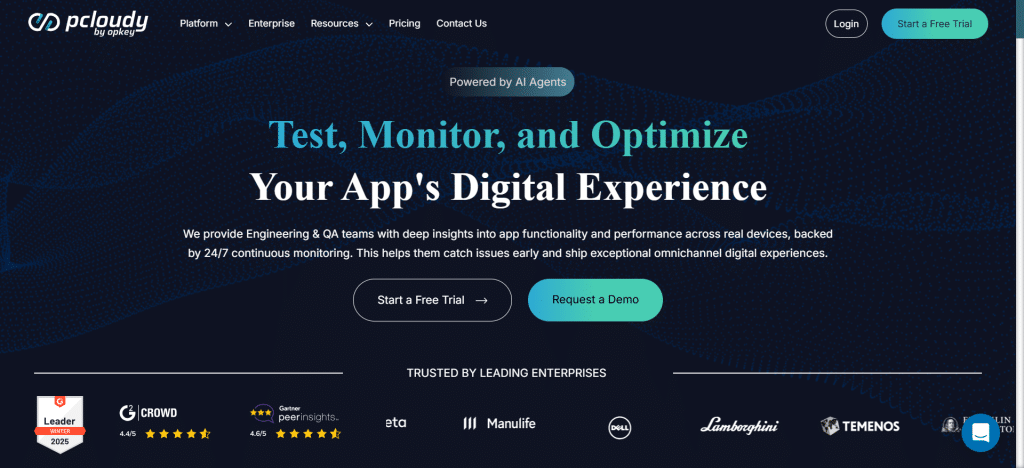
Pcloudy is a leading choice in the market for enterprise mobile teams belonging to different industries trying to adopt vibe testing. Built for AI-powered QA, the platform combines natural language and six highly specialized AI agents to deliver mobile first and adaptive automation at scale.
Key Features:
- Six different specialized AI agents for creating tests, visual regression, self-healing, test orchestration, synthetic monitoring, and test observability
- Creation of natural language tests powered by these AI agents
- Access to more than 5000 real iOS and Android devices
Pros:
- Enterprise Mobile testing enables teams to create complex tests and maintain them with negligible manual effort
- Maintenance reduction up to 80% with AI-driven self-healing
- Comprehensive mobile coverage, thanks to its scalable and diverse real device cloud
- Beneficial for non-technical users due to its intuitive natural language interface
Cons:
- Enterprise-focused pricing may not suit small teams or individual developers
- Initial onboarding is required to leverage all AI agents effectively
Best for:
Enterprise QA teams that need AI-powered vibe testing and access to more than 5000 real mobile devices.
Pricing:
30-day free trial available, no strings attached, and you can contact the sales team for Enterprise pricing.
Also check out: Pcloudy 6.14: Elevate Your Testing with QPilot.AI’s Synchronous Testing
#2. TestRigor

With strong emphasis on automation using plain English, this tool allows QA teams to provide accurate descriptions of expected outcomes and user flows without having to write code. Non-technical contributors greatly benefit from its features.
Key Features:
- Seamless CI/ CD integrations with extensive mobile and web support.
- Natural language scripting.
- AI-powered test execution and self-healing
Pros:
- Minimal configuration and quick setup
- Highly accessible to non-technical contributors
Cons:
- Limited real device testing
- Less advanced visual validation capabilities
Best for:
QA teams looking forward to test automation using plain English for both mobile and web applications without having any in-depth scripting knowledge.
Pricing:
Free trial available along with Enterprise pricing
#3. Harness AI Test Automation

Harness AI test automation emphasizes intent-based testing within CI/CD pipelines, making the framework perfect for DevOps-centric QA teams. It keeps adapting as apps evolve.
Key Features:
- Intent-driven natural language test generation
- AI-powered test orchestration and self-healing
Pros:
- Reduced test maintenance
- Strong support for CI/CD integration
Cons:
- Lack of native device cloud access, only available through integrations
- Steep learning curve for those team members who are not familiar with its ecosystem
Best for:
DevOps-centric QA teams that require intent-based AI-powered testing, along with seamless CI/CD integrations
Pricing:
Demo or trial available, contact sales for further details.
#4. Mabl

Mabl enables QA teams to create autonomous test agents capable of automatically generating, executing, and maintaining tests on the basis of requirements. Therefore, teams are able to maintain quality cross-platform coverage with reduced manual effort.
Key Features:
- Support for API, mobile, and web testing
- AI-powered autonomous test agents
Pros :
- Cross platform support
- Autonomous creation of tests and test maintenance
Cons:
- Integration-dependent real device testing
- Less advanced visual validation capabilities
Best for:
Teams on the lookout for AI-powered autonomous test agents for streamlining both mobile and web testing
Pricing:
Free trial available along with Enterprise pricing
#5. Autify

Autify offers no-code AI-based testing for web and mobile applications so that teams can quickly create and run tests even without any knowledge of scripting. Amid frequent UI updates, self-healing automation provides reliability.
Key Features:
- AI assisted generation of test script
- Self-healing test automation
- Cross-platform mobile and web support
Pros:
- No-code interface beneficial for non-technical contributors
- Reduced maintenance overhead with self-healing
Cons
- Limitations with visual validation capabilities
- Higher tier plans required for Enterprise features
Best for:
Teams that like to prioritize cross-platform testing, with simplicity and minimal scripting
Pricing:
Availability of a free trial, along with the option to contact sales for further inquiries
#6. Applitools

With a strong emphasis on visual vibe validation, Applitools helps in detecting broken UI elements, layout inconsistencies, and user experience issues with the help of AI across various platforms and devices.
Key Features:
- Seamless integration with existing frameworks
- Automated comparisons across various devices
- Visual AI for validating UX and layout
Pros:
- Offers support for UI consistency across platforms
- One of the best visual validations in-class
Cons:
- Full coverage needs existing test scripts
Best, for:
Teams focusing on UX and visual consistency in apps.
Pricing:
Free trial available, along with Enterprise pricing
#7. Kane AI by TestMu

Kane AI by LambdaTest is an LLM-powered cloud-based testing tool for both mobile and web applications. It allows teams to use natural language to write tests while providing scalability across various devices.
Key Features:
- Thousands of cloud-based real devices
- AI-based self-healing automation
- Test creation using natural language and GPT level
Pros:
- Massive real device cloud
- Scalable cloud-based test execution
Cons:
- Advanced features might call for Enterprise plan.
- Limited visual testing in comparison with other tools
Best for:
Teams in need of GPT-powered and scalable cloud testing with decent device coverage.
Pricing:
Availability of a free trial along with Enterprise pricing
#8. Testsigma

Testsigma is one of the most popular open-source testing platform that enables QA teams to use natural language to write test steps as AI caters to maintenance and execution across different API, mobile, and web platforms.
Key Features:
- AI-powered self-healing
- Cloud-powered support across platforms
Pros:
- AI-powered test maintenance
- Open-source.
- Extensible framework
Cons:
- Extra setup effort for Enterprise integrations
- Limited visual validation
Best for:
Teams looking out for an NLP-based open source testing platform for mobile, API, and web testing.
Pricing:
Free plan since it’s Open-source with availability of Enterprise pricing
#9. Perfecto

Perfecto is a tactful combination of access to real device cloud along with agentic AI testing so that QA teams can keep on creating goal-oriented tests without having to write test scripts.
Key Features:
- Goal-oriented test generation using AI
- Real device cloud for web and mobile testing
Pros:
- Cross-platform support
- Reduced scripting needs with agentic AI
Cons:
- High pricing for small teams
#10. Katalon

Katalon is a popular, all-in-one AI automated testing platform that offers multi-platform support, self-healing automation, and test generation powered by GPT-4 for mobile, API, and web testing.
Key Features:
- Natural language test creation powered by GPT-4
- High cross-platform coverage, including web, API, and mobile
Pros:
- Intuitive and easy-to-use interface for non-technical users
- Comprehensive support for multiple platforms
Cons:
- Using advanced features requires training
- Additional setup required for some integrations
Best for:
Teams looking out for an AI-powered platform that provides comprehensiveness when it comes to fulfilling mobile, API, and web testing needs.
Pricing:
Enterprise pricing, along with the availability of a free trial
Top 10 Vibe Testing Tools in 2026 [Detailed Comparison]
| S.No. | Tools | Natural Language Support | Self Healing | Device Coverage | UX and Visual Validation | CI/CD Integration | Appropriate For |
|---|---|---|---|---|---|---|---|
| 1. | Pcloudy + QPilot.AI | Comprises six AI agents to interpret prompts and perform other functions | Approximately 80% test maintenance reduction | More than 5,000 real iOS and Android devices | Visual regression, along with UX consistency | GitLab, Azure, GitHub, Jenkins | Enterprise-level mobile vibe testing |
| 2. | TestRigor | Plain English language scripts | AI-powered | Web and mobile through integration | Comes with limitations | CI/CD Native | Non-technical team members automating with plain English |
| 3. | Harness AI | Driven by intent | AI-powered | Web and mobile through integration | Has certain limitations | Native DevOps integration | CI/CD integrated intent testing by DevOps teams |
| 4. | Mabl | Driven by requirement | AI agents automatically adapt | Mobile + web + API | Visual and user experience checks | Native CI/CD | Teams requiring autonomous AI agents |
| 5. | Autify | AI-assisted creation of tests | Offers self-healing capabilities | Web + mobile | Has limitations | GitHub, Jenkins | No code web and mobile QA teams |
| 6. | Applitools | Limited functionality | AI-driven | Web through integrations | Leading visual AI | Native CI/CD | Teams emphasizing UX and visual validation |
| 7. | LambdaTest KaneAI | Powered by LLM | AI-driven | Thousands of devices in the cloud | Visual checks | Native CI/CD | GPT-powered and scalable cloud testing |
| 8. | Testsigma | Based on NLP | AI-powered | Mobile plus web plus API | Comes with limitations | GitHub and Jenkins | AI healing and open source NLP testing |
| 9. | Perfecto | Goal-oriented prompting | AI driven | Real device cloud | UX and visual validation | Native CI/CD | Agent AI Testing based on goals |
| 10. | Katalon | Test generation GPT-4 level | Self-healing capabilities | Mobile + web + API | UX and visual checks | Native CI/CD | All-in-one web and mobile platform |
Conclusion
To sum up, vibe testing can also mean redefining quality assurance for the current AI-powered development era. Did you know that the AI-based testing market is projected to grow from $856.7 million in 2024 to $3.82 billion at a 20.9 % CAGR by 2032? QA teams are successfully able to reduce maintenance overhead, accelerate release cycles, and ensure the appropriate working of applications across various platforms by leveraging the power of self-healing automation, AI agents, and natural language prompts. Pcloudy with QPilot.AI is a leading choice that offers a mobile-first approach along with extensive coverage for real devices and six AI agents. Also, sign up for Pcloudy free trial for 30 days to explore deeper and crank your mobile testing game up a notch!
FAQs on Vibe Coding
What is vibe coding?
Vibe coding describes the desired functionality or outcome, whereas AI automatically generates corresponding code.
Are non-technical team members able to use vibe testing tools with ease?
Yes, in fact, the natural language interfaces enable product managers, business analysts, and designers to make significant contributions to testing even though they don’t have any coding knowledge.
Do vibe testing tools seamlessly integrate with CI/ CD pipelines?
Yes, most top vibe testing tools in 2026 offer plugin-based or native integration with popular CI/ CD systems such as Azure, DevOps, GitHub, and Jenkins, also enabling automated execution of tests during deployments and builds.
Read more:


 R Dinakar