
Test automation is no longer just about automating repetitive tests. In 2026, it has become a continuous, AI-driven process integrated across the entire software development lifecycle, from code creation to post-release monitoring.
The global automation testing market was valued at USD 32.7 billion in 2025 and is projected to grow from USD 37.5 billion in 2026 to USD 89.0 billion by 2033, at a CAGR of 12.9%. As AI-generated code, faster release cycles, and increasingly complex applications become the norm, QA teams are adopting smarter approaches such as agentic AI, self-healing automation, AI-generated test cases, continuous testing, and real device testing to maintain quality at scale.
In this article, we’ll explore the top 20 test automation trends 2026 that are shaping the future of software testing and what they mean for QA and engineering teams.
TL;DR
Category 1: AI and Autonomous Testing
1: Agentic AI Testing
Agentic AI testing is one of the biggest test automation trends 2026. With over 40% of code written in 2025 generated by AI, traditional testing methods are struggling to keep up. Agentic AI testing addresses this gap by using AI agents that can plan, execute, analyze, and adapt test strategies autonomously instead of simply running predefined scripts.
A good example is QPilot.AI, which uses a multi-agent architecture to automate different stages of the testing lifecycle. Its agents, Qgen, AutoHeal, QuantumRun, QObserve, and Synthetic Monitoring, work together to generate test cases, self-heal scripts, orchestrate test execution, analyze failures, and monitor applications after release.
Test on real devices. Ship with confidence.
2: AI-Generated Test Cases
AI is making test case creation faster by turning natural-language requirements, user stories, and application flows into structured test scenarios. Instead of manually writing every test case, QA teams can define the intended behavior while AI generates test steps, expected results, and relevant positive, negative, and edge-case scenarios. This reduces the time spent on repetitive test design and helps teams expand test coverage.
Pcloudy’s QPilot.AI Qgen automatically generates functional test cases from user stories, requirements, UI mockups, API specifications, and live application URLs. It creates structured test cases with preconditions, test steps, expected results, and test data, helping teams move from requirements to test-ready scenarios more efficiently.
3: Self-Healing Test Automation
One of the biggest challenges in test automation is maintaining scripts when applications change. Even minor UI updates, such as renamed element IDs, modified locators, or changes in the page structure, can cause automated tests to fail, requiring engineers to spend time identifying and fixing broken scripts.
Self-healing test automation addresses this problem by using AI to detect changes in application elements and automatically update affected locators or selectors wherever possible. This reduces test failures caused by UI changes, minimizes manual script maintenance, and helps keep automated test suites reliable across frequent application updates.
Pcloudy’s QPilot.AI AutoHeal automatically identifies broken locators and repairs them during test execution, helping teams reduce script maintenance efforts by up to 70% while improving the stability of automated test suites.
4: Predictive Test Analytics
Modern AI-powered testing platforms can analyze historical test execution data, defect trends, code changes, and test outcomes to identify patterns that indicate which tests are most likely to fail in upcoming builds. Instead of running every test with the same priority, teams can use these insights to focus on the highest-risk areas first.
Predictive test analytics helps QA teams optimize test execution, accelerate feedback during continuous integration, and detect potential issues earlier in the development cycle. This enables risk-based testing, where the most critical and failure-prone test cases are prioritized, reducing overall execution time while maintaining confidence in software quality.
5: AI-Powered Failure Analysis
As test suites grow, identifying the reason behind a failed test often takes more time than fixing the issue itself. Engineers typically need to sift through logs, screenshots, stack traces, and execution reports to determine whether the failure was caused by a code regression, an unstable test, an environment issue, or infrastructure problems.
AI-powered failure analysis simplifies this process by automatically analyzing test artifacts and classifying the root cause of failures. Instead of presenting raw logs, AI highlights the most likely cause, groups similar failures, and provides actionable insights to help teams resolve issues faster. This significantly reduces manual triage time and enables developers and QA engineers to focus on fixing genuine defects rather than investigating every failed test.
Pcloudy’s QPilot.AI QObserve uses AI-powered observability to analyze test execution data, classify failures, identify root causes, and provide actionable insights, helping teams reduce debugging time and accelerate issue resolution.
6: Testing AI-Powered Features
As AI becomes an integral part of modern applications, testing is no longer limited to verifying whether a specific input always produces the same output. Unlike traditional software, AI models can generate different yet valid responses for the same prompt, making conventional pass/fail testing insufficient.
Testing AI-powered features requires new validation strategies that evaluate response quality, accuracy, relevance, consistency, safety, and fairness rather than exact output matching.
QA teams must also monitor AI systems for issues such as hallucinations, bias, prompt sensitivity, model drift, and data drift to ensure reliable performance over time. As organizations increasingly integrate generative AI into customer-facing and internal applications, AI-specific testing practices are becoming a core part of quality engineering.
Category 2: Shift-Left and Continuous Testing
7: Shift-Left Testing as Standard Practice
Shift-left testing has evolved from a best practice into a standard approach for modern software development. Rather than treating testing as a final step before release, QA teams collaborate with developers, product managers, and business stakeholders from the earliest stages of the software development lifecycle.
By participating in requirement reviews, design discussions, API development, and code implementation, testers can identify defects long before they reach production. Automated tests are created alongside application features, allowing teams to validate functionality continuously as code is written. This early feedback reduces the cost of fixing defects, improves software quality, and enables faster, more predictable release cycles.
8: Continuous Testing in CI/CD Pipelines
Continuous testing has become a core component of modern CI/CD pipelines. Instead of waiting until the end of the development cycle, automated tests are executed every time code is committed, merged, or deployed. Smoke, regression, API, integration, security, and other automated tests run continuously, providing developers with rapid feedback on the impact of their changes.
This approach enables teams to identify defects within minutes, fix issues before they reach later stages of the pipeline, and maintain a stable codebase despite frequent releases. Rather than acting as a final approval gate before deployment, testing becomes a continuous feedback loop that supports faster development, reduces release risk, and improves overall software quality.
Pcloudy integrates seamlessly with leading CI/CD platforms such as Jenkins, GitHub Actions, GitLab CI/CD, Azure DevOps, CircleCI, and Bamboo, enabling automated test execution across real devices and browsers with every build. Combined with QPilot.AI, teams can accelerate test execution, prioritize critical tests, and deliver continuous quality throughout the software development lifecycle.
9: In-Sprint Test Automation
In-sprint test automation is becoming the preferred approach for agile development teams. Instead of waiting until a feature is complete, QA engineers create and automate test cases within the same sprint in which the feature is being developed. Developers and testers work in parallel, ensuring that automation keeps pace with development rather than lagging behind it.
This collaborative approach provides faster feedback, uncovers defects earlier, and reduces the accumulation of testing debt. By having automated tests ready before code is merged, teams can validate new functionality immediately, minimize regression risks, and maintain a stable release pipeline without delaying delivery.
10: Shift-Right — Post-Release Continuous Monitoring
Category 3: Real Device and Mobile Testing
Quality assurance no longer ends when an application is deployed. Modern engineering teams are extending testing beyond production releases through continuous monitoring and real-world validation. Functional testing is now complemented by ongoing stress testing, security scanning, resilience testing, and performance monitoring to ensure applications remain reliable under changing conditions.
Many organizations are also adopting chaos engineering practices, intentionally introducing failures such as service outages or network latency to evaluate how systems respond and recover. These continuous post-release checks help teams identify issues before they affect users, improve application resilience, and maintain a consistent user experience across production environments.
Pcloudy’s Synthetic Monitoring agent continuously monitors application health on real devices after deployment, enabling teams to detect performance issues, validate user journeys, and identify production problems before they impact end users.
11: Real Device Cloud Testing at Scale
As mobile applications become more complex, testing exclusively on emulators and simulators is no longer sufficient for production-ready validation. While virtual environments remain useful during early development, they cannot accurately replicate real-world conditions such as hardware variations, operating system behavior, network fluctuations, battery performance, or device-specific interactions.
To ensure reliable user experiences, enterprise QA teams are increasingly relying on real device clouds that provide instant access to thousands of physical Android and iOS devices. Testing on real hardware enables teams to identify issues that emulators often miss, improve release confidence, and validate application behavior across diverse device and OS combinations.
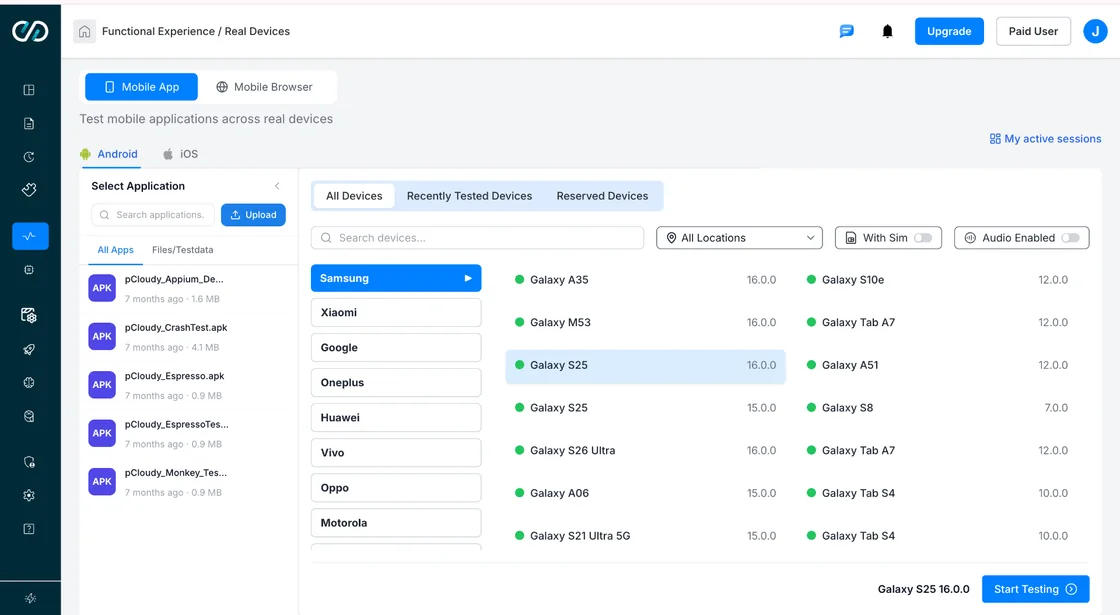
Pcloudy provides access to 5,000+ real Android and iOS devices with under-3-second device connection times and zero queue time, enabling enterprise teams to execute large-scale mobile testing efficiently.
12: AI-Augmented Mobile Performance Testing
Mobile performance testing has evolved beyond simply verifying whether an application meets predefined response time thresholds. Modern QA teams continuously monitor a wide range of performance indicators throughout the development lifecycle to ensure applications deliver a smooth and reliable user experience across different devices and conditions.
AI-powered performance testing analyzes metrics such as CPU utilization, memory consumption, battery usage, crash rates, ANR (Application Not Responding) events, network latency, frame rendering performance, and application startup time. By continuously evaluating these metrics across every build, teams can detect performance regressions early and optimize applications before they reach production.
Pcloudy captures and analyzes 60+ mobile performance metrics during every real-device test session, giving teams detailed insights into application health, stability, and performance across multiple devices and operating systems.
13: Cross-Platform Test Automation
Organizations are increasingly adopting cross-platform automation strategies to reduce duplicated testing efforts while maintaining comprehensive coverage. Frameworks such as Appium enable teams to automate both Android and iOS applications using a shared test suite, improving efficiency and reducing maintenance costs for common user workflows.
At the same time, native automation frameworks like Espresso for Android and XCUITest for iOS continue to play an important role in validating platform-specific functionality, performance, and user interactions. By combining cross-platform automation with native testing where needed, QA teams achieve broader coverage without sacrificing the depth and accuracy required for enterprise-grade mobile applications.
Category 4: Low-Code and No-Code Automation
14: Low-Code and No-Code Test Automation
Low-code and no-code test automation platforms are making software testing more accessible by reducing the need for extensive programming knowledge. Using visual workflows, drag-and-drop interfaces, and pre-built components, QA professionals, business analysts, and other non-technical users can create, modify, and execute automated test cases with minimal coding effort. This helps organizations improve test coverage, accelerate automation adoption, and reduce the time required to validate new features.
In 2026, these platforms are becoming even more powerful with the addition of AI-driven natural language automation. Instead of manually scripting every test, users can simply describe a scenario, for example, “Verify that the login button successfully signs in a registered user”, and AI generates an executable test script. This enables faster test creation, simplifies maintenance, and allows teams to focus more on validating business logic than writing automation code.
Category 5: Security and Compliance Testing
15: Security Testing Integrated into CI/CD (DevSecOps)
Security testing has become a fundamental part of the software development lifecycle rather than a separate activity performed just before release. As organizations face increasingly sophisticated cyber threats and stricter regulatory requirements, security checks are now integrated directly into CI/CD pipelines through DevSecOps practices. This allows teams to identify and address vulnerabilities continuously as software is developed and deployed.
Modern DevSecOps pipelines combine Static Application Security Testing (SAST), which analyzes source code for security flaws during development, with Dynamic Application Security Testing (DAST), which evaluates running applications for vulnerabilities during testing and deployment. By embedding these security scans into every build, teams receive immediate feedback, reduce remediation costs, and strengthen application security before software reaches production.
This approach is particularly important for highly regulated industries such as banking, financial services, and insurance (BFSI). For teams responsible for mobile banking application testing, integrating security testing throughout the development lifecycle is essential to identify vulnerabilities before applications reach customers. Under PCI DSS 4.0, organizations handling payment card data are expected to embed secure development practices and vulnerability testing into their software development processes.
Rather than being an engineering preference, incorporating SAST and DAST into CI/CD pipelines has become an essential part of maintaining compliance, protecting sensitive customer data, and reducing security risks before every release.
16: Compliance-Mapped Test Automation
As regulatory requirements continue to grow, organizations in industries such as banking, healthcare, insurance, and government are moving away from manual compliance documentation toward automated compliance validation. Instead of collecting evidence after testing is complete, modern test automation platforms map test cases directly to regulatory requirements, ensuring that every requirement is validated throughout the software development lifecycle.
This approach automatically generates audit-ready evidence, including test execution logs, screenshots, reports, and traceability records for every build. By linking automated tests to compliance frameworks such as FFIEC, PCI DSS, and MAS TRM, organizations can simplify audits, reduce manual documentation efforts, and demonstrate continuous compliance with greater accuracy and consistency.
Pcloudy provides a secure testing platform with certifications including PCI DSS, SOC 2 Type II, ISO 27001, GDPR, and HIPAA. The platform automatically captures test execution evidence, logs, screenshots, videos, and reports for every session, helping teams streamline compliance reporting and maintain audit-ready documentation.
Category 6: Architecture and Infrastructure Trends
17: API-First Test Automation
As applications increasingly adopt microservices and API-driven architectures, API testing has become the first layer of automation rather than an afterthought. Since APIs connect services, mobile applications, web frontends, and third-party integrations, validating them early helps teams identify issues before they impact the user interface.
Modern development teams automate API testing alongside feature development and integrate it into CI/CD pipelines. They also maintain API contracts and documentation as services evolve, ensuring changes do not break existing functionality. By testing APIs before UI layers, teams receive faster feedback, improve test stability, and reduce the cost of defect resolution.
Pcloudy’s QPilot.AI API Testing Agent simplifies API test creation, execution, and maintenance using AI, enabling teams to automate API validation and integrate it seamlessly into modern development pipelines.
18: Cloud-Native Test Infrastructure
Traditional on-premises device labs and locally managed testing environments are steadily giving way to cloud-native testing platforms. As software teams release updates more frequently, they need testing infrastructure that can scale on demand without the operational overhead of maintaining physical devices and servers.
Cloud-native testing platforms provide instant access to browsers, operating systems, and real devices while enabling distributed teams to collaborate from anywhere. They also reduce infrastructure costs, improve resource utilization, and support faster test execution through elastic scaling. As cloud adoption continues to grow, organizations are increasingly choosing cloud-based testing to improve flexibility, accelerate releases, and simplify infrastructure management.
Pcloudy offers a unified testing platform across public cloud, private cloud, and Lab-in-a-Box on-premises deployments, allowing organizations to choose the deployment model that best meets their security, compliance, and scalability requirements.
19: Test Orchestration and Parallel Execution
With applications being released multiple times a day, executing tests sequentially is no longer practical. Modern QA teams rely on intelligent test orchestration to determine which tests should run, on which devices or environments, and in what order. Combined with parallel execution, this approach significantly reduces overall test execution time while maximizing infrastructure utilization.
Intelligent orchestration also prioritizes high-risk or business-critical test cases, balances workloads across available resources, and ensures faster feedback for developers. Running automated tests simultaneously across multiple devices, browsers, and operating systems enables organizations to validate software at scale without slowing down release cycles.
Pcloudy’s QPilot.AI QuantumRun intelligently orchestrates and executes automated tests across real devices in parallel, helping teams shorten feedback cycles, optimize resource usage, and accelerate software delivery without compromising test coverage.
Category 7: Team and Process Trends
20: QA Engineers Evolving into Quality Engineers
The role of QA professionals has expanded far beyond writing and executing test cases. As software development becomes increasingly automated and AI-driven, organizations are looking for professionals who can ensure quality across the entire software development lifecycle rather than only during the testing phase. This shift has given rise to the role of the Quality Engineer, who collaborates closely with developers, DevOps engineers, product teams, and security specialists from the earliest stages of development through production.
According to QA automation trends modern quality engineers are expected to work with CI/CD pipelines, cloud environments, test automation frameworks, APIs, observability tools, and data-driven quality metrics. They use AI-assisted testing tools, integrate automated quality checks into development workflows, and leverage analytics to improve software reliability.
As the traditional boundary between developers and testers continues to disappear, many QA professionals are transitioning into quality engineering and test platform engineering roles that focus on building scalable testing ecosystems instead of simply executing tests.
Read More: Best Automation Testing Tools in 2026: [With Comparison]
How to Choose Where to Start
Not every organization needs to adopt all 20 test automation trends at once. The right priorities depend on your application architecture, release frequency, industry, and team maturity. Here’s where to focus first based on your testing needs.
If your team spends too much time creating and maintaining test scripts
Start with AI-generated test cases (Trend 2) and self-healing test automation (Trend 3). AI can generate test cases from user stories, requirements, or natural language prompts, while self-healing automation automatically updates broken locators when applications change. Together, these capabilities reduce manual effort, improve test coverage, and make AI test automation easier to adopt without constantly rewriting scripts.
If you release software multiple times a week
Prioritize continuous testing in CI/CD pipelines (Trend 8) and in-sprint test automation (Trend 9). Automated smoke, regression, API, and security tests should run with every code change to provide developers with rapid feedback. Manual regression testing cannot keep pace with modern delivery cycles, making continuous quality engineering an essential part of the development process.
If you’re building mobile applications
Invest in real device cloud testing (Trend – 11) before expanding your automation strategy. Testing on real Android and iOS devices uncovers hardware-specific issues, operating system differences, and real-world performance problems that emulators often miss. Pair this with AI-augmented mobile performance testing (Trend – 12) to monitor CPU usage, memory consumption, battery drain, crash rates, ANRs, and network performance across every build. Together, these practices form the foundation of effective types of mobile app testing.
| Several trends discussed in this guide, including real device cloud testing, AI-powered mobile performance testing, cross-platform automation, and continuous testing, are transforming how organizations test mobile applications. A strong mobile app testing strategy combines these modern practices to ensure Android and iOS apps deliver consistent performance, reliability, security, and user experience across diverse devices and operating environments. |
If you develop software for regulated industries
Organizations in banking, FinTech, healthcare, insurance, and government should prioritize security testing integrated into CI/CD (Trend 15) and compliance-mapped test automation (Trend 16). Embedding SAST, DAST, and compliance validation into your development pipeline helps identify vulnerabilities early while generating the audit evidence required by standards such as PCI DSS, HIPAA, ISO 27001, and SOC 2. For regulated environments, these capabilities are essential components of enterprise test automation, not optional additions.
If you’re expanding your QA team
Adopt low-code and no-code test automation (Trend 14) together with shift-left testing (Trend 7). Low-code platforms enable testers, business analysts, and domain experts to contribute to automation without extensive programming skills, while shift-left practices ensure testing begins during requirements, design, and development. This combination helps teams scale automation faster and supports long-term QA transformation.
If you’re managing enterprise-scale testing
As your application portfolio and test suites grow, test orchestration and parallel execution (Trend 19) become increasingly valuable. Combine these with agentic AI (Trend 1) to intelligently prioritize, distribute, execute, and analyze tests across devices, browsers, and environments. This approach reduces execution time, optimizes infrastructure usage, and enables intelligent test automation that scales with enterprise software delivery.
Direct Comparison: Trend Maturity in 2026
The following table provides a quick overview of where each software testing trends 2026 stands, its level of industry adoption, and the teams that are likely to benefit the most. Use it to prioritize your test automation strategy based on your organization’s current maturity and business goals.
| Trend | Maturity in 2026 | Who It Impacts Most |
|---|---|---|
| Agentic AI Testing | Early Mainstream | Enterprise QA teams, Platform Engineers |
| AI-Generated Test Cases | Mainstream | QA Engineers, SDETs |
| Self-Healing Test Automation | Mainstream | Test Automation Engineers, QA Teams |
| Predictive Test Analytics | Early Mainstream | QA Leads, Engineering Managers |
| AI-Powered Failure Analysis | Early Mainstream | QA Engineers, Developers |
| Testing AI-Powered Features | Emerging | Teams Building AI Applications |
| Shift-Left Testing | Fully Standard | QA Teams, Developers, Product Teams |
| Continuous Testing in CI/CD | Fully Standard | DevOps Teams, QA Engineers |
| In-Sprint Test Automation | Mainstream | Agile QA Teams, Scrum Teams |
| Shift-Right Continuous Monitoring | Mainstream | DevOps, SRE, QA Teams |
| Real Device Cloud Testing | Fully Standard | Mobile QA Teams, Test Engineers |
| AI-Augmented Mobile Performance Testing | Mainstream | Mobile QA, Performance Engineers |
| Cross-Platform Test Automation | Fully Standard | Mobile QA Teams |
| Low-Code and No-Code Test Automation | Mainstream | Mixed-Skill QA Teams, Business Testers |
| DevSecOps (Security Testing in CI/CD) | Mainstream | All Development Teams; Essential for Regulated Industries |
| Compliance-Mapped Test Automation | Early Mainstream | Banking, FinTech, Healthcare, Government |
| API-First Test Automation | Fully Standard | Backend Developers, API Testing Teams |
| Cloud-Native Test Infrastructure | Fully Standard | Enterprise QA Teams, DevOps Teams |
| Intelligent Test Orchestration | Mainstream | Platform Engineers, QA Leads |
| QA Engineers Evolving into Quality Engineers | Early Mainstream | QA Leads, Engineering Managers |
Summary: 20 Test Automation Trends Shaping Software Quality in 2026
Here’s a quick recap of the key trends:
- Agentic AI Testing: Autonomous AI agents plan, generate, execute, and optimize test workflows with minimal human intervention.
- AI-Generated Test Cases: Natural language prompts and requirements are converted into executable test cases, reducing manual test authoring.
- Self-Healing Test Automation: AI automatically repairs broken locators and selectors, minimizing script maintenance.
- Predictive Test Analytics: Historical test data is analyzed to prioritize the highest-risk tests before execution begins.
- AI-Powered Failure Analysis: AI identifies likely root causes by analyzing logs, screenshots, and execution artifacts, reducing debugging time.
- Testing AI-Powered Features: New testing strategies validate probabilistic outputs, monitor model drift, and detect bias in AI applications.
- Shift-Left Testing: Testing starts during requirements, design, and development instead of after coding is complete.
- Continuous Testing in CI/CD: Automated smoke, regression, API, and security tests run with every code commit to provide continuous feedback.
- In-Sprint Test Automation: Test automation is created alongside feature development within the same sprint, reducing regression risk.
- Shift-Right Monitoring: Continuous monitoring, resilience testing, and production validation extend quality beyond software releases.
- Real Device Cloud Testing: Enterprise teams rely on thousands of real Android and iOS devices instead of emulator-only testing.
- AI-Augmented Mobile Performance Testing: AI continuously analyzes performance metrics such as CPU, memory, battery usage, crashes, and network performance on real devices.
- Cross-Platform Test Automation: Shared automation frameworks such as Appium, together with Espresso and XCUITest, provide comprehensive mobile test coverage.
- Low-Code and No-Code Test Automation: Visual interfaces and AI-powered natural language automation enable faster test creation with minimal coding.
- Security Testing in CI/CD (DevSecOps): SAST and DAST are embedded into development pipelines to detect vulnerabilities throughout the SDLC.
- Compliance-Mapped Test Automation: Automated tests are linked to regulatory requirements, generating audit-ready compliance evidence for every build.
- API-First Test Automation: API validation becomes the first layer of testing for microservices and modern distributed applications.
- Cloud-Native Test Infrastructure: Scalable, on-demand cloud platforms replace traditional on-premises testing environments.
- Test Orchestration and Parallel Execution: Intelligent scheduling and parallel execution accelerate feedback across devices, browsers, and environments.
- QA Engineers Evolving into Quality Engineers: QA professionals are taking ownership of quality across the entire software development lifecycle by combining testing, automation, DevOps, cloud, and AI expertise.
Together, these trends represent the future of test automation, AI-powered testing, and quality engineering. Organizations that adopt the trends most relevant to their products, teams, and release processes will be better positioned to deliver high-quality software faster while keeping pace with rapidly evolving development practices.
Related Reading:
- The Gap Between Testing and Reality: Why Bugs Keep Reaching Production
- Finding Bugs in Mobile Applications: A Practical Guide for QA Teams
- Types of Mobile App Testing: A Complete Guide for QA Teams
- Mobile App Testing: What It Is, How It Works, and Types
- How to Test Mobile Applications: Strategy, Process, and Best Practices
- Types of Mobile App Testing


 Veethee Dixit
![Best Bug Tracking Tools for QA Teams [2026]](https://pcloudyprod-engpgtajd7c4g9a8.a03.azurefd.net/wp-content/uploads/2026/08/bug-tracking-tools-thumbnail.jpg)

 Jeroline


